Call for Papers and Demos
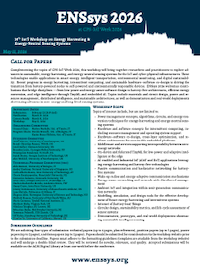
Download the CfP
Important Dates
- Submission:
Feb 21March 07, 2026 (23:59 AoE) [extended] - Notification: March 24, 2026
- Camera Ready: March 31, 2026
- Workshop: May 11, 2026
Complementing the topics of CPS-IoT Week 2026, this workshop will bring together researchers and practitioners to explore advances in sustainable, energy-harvesting, and energy-neutral sensing systems for the IoT and cyber-physical infrastructures. These technologies enable applications in smart energy, intelligent transportation, environmental monitoring, and digital sustainability. Recent progress in energy harvesting, intermittent computing, and sustainable hardware–software co-design is driving the transition from battery-powered nodes to self-powered and environmentally responsible devices. ENSsys 2026 welcomes contributions that bridge disciplines — from low-power and energy-aware software design to battery-free architectures, efficient energy conversion, and edge intelligence through TinyML and embedded AI. Topics include materials and circuit design, power and resource management, distributed intelligence, and sustainable architecture, as well as demonstrators and real-world deployments showcasing advances in zero-energy and long-lived sensing systems.
High-quality technical articles are solicited, describing advances in energy-neutral and battery-free sensing systems enabled by innovative energy harvesting, energy-aware scheduling, and sustainable design methodologies. Contributions reporting practical deployments, prototypes, and real-world implementation experiences are particularly encouraged, as are forward-looking position papers. The call also welcomes work on ultra-low-power and intelligent communication paradigms, including passive and backscatter communication, wake-up radios, and Ambient IoT integration, alongside interdisciplinary approaches that combine embedded AI, communication efficiency, system resilience, and environmental sustainability to enable pervasive, self-powered sensing.
Topics of interest include, but are not limited to, the following:
- Power management concepts, algorithms, circuits, and energy conversion techniques for energy-harvesting and energy-neutral sensing systems
- Hardware and software concepts for intermittent computing, including resource management and operating system support
- Hardware–software co-design, cross-layer optimization, and resilient architectures for sustainable embedded platforms
- Middleware and services supporting interoperability between zero-energy networks
- On-device and federated TinyML for low-power and adaptive intelligence at the edge
- AI-enabled and Industrial IoT (AIoT and IIoT) applications leveraging energy-harvesting and battery-free technologies
- Passive communication and backscatter networking for battery-free systems
- Wake-up radios and energy-adaptive communication mechanisms
- Energy-aware networking and network-wide distributed management
- Ambient IoT and integration within next-generation communication networks
- Modelling, simulation, and design tools for the effective development of future energy-harvesting and intermittent systems
- Internet of (battery-less) Things
- Circular design, sustainability metrics, and life-cycle assessment of sensor systems
- Demonstrators, prototypes, and real-world deployments showcasing sustainable intelligent sensing
We solicit three types of paper submission:
- Technical Papers: up to 6 pages (including everything except references), reporting on novel research, to be presented at the workshop as an oral presentation;
- Position Papers up to 3 pages (including everything), reporting on new research directions and/or a controversial debate of past research, to be presented at the workshop as a short pitch with interactive discussion;
- Demo/Poster Papers up to 2 pages (including everything), to be presented at the workshop as an interactive demonstration or poster respectively.
Submissions should be previously unpublished, and not currently under review by another conference or journal. Papers should be submitted for consideration via the workshop website, prior to the submission deadline, and must adhere to the provided formatting guidelines. Papers will undergo double-blind review, authors are asked to remove their names and other identifying statements from submissions. Submissions will be reviewed for novelty, relevance and quality. Accepted papers will be available on IEEE Xplore on the first day of the conference.
All papers should be submitted through EASYCHAIR
- Submission:
Feb 21March 07, 2026 (23:59 AoE) [extended] - Notification: March 24, 2026
- Camera Ready: March 31, 2026
- Workshop: May 11, 2026